
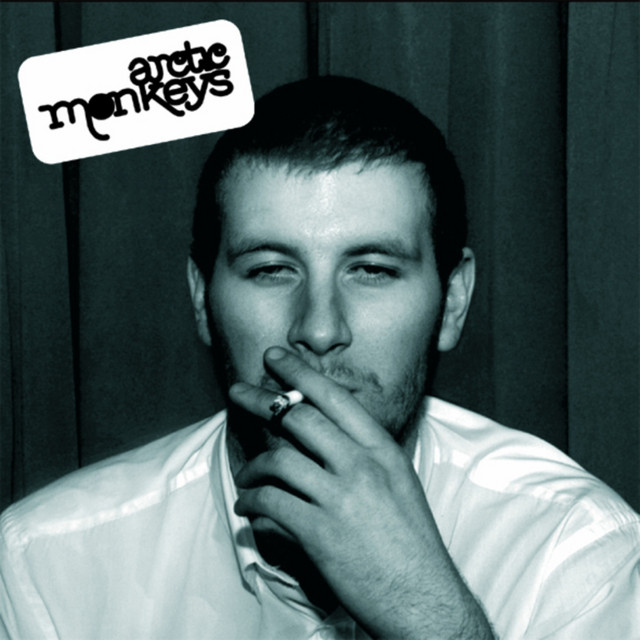
Twenty Years of Observation and Urgency: An Analytical Look At Arctic Monkeys’ Debut
By Aiden Richards
Twenty years after its release, Arctic Monkeys debut album Whatever People Say I Am, That’s What I’m Not remains one of the most incisive debut albums of the 21st century. Not because of nostalgia, but because of how precisely it captured a moment and translated it into lasting influence.
Released Jan. 23, 2006, Arctic Monkeys’ first full-length album distinguished itself through specificity. Rather than leaning on vague expressions of youth or rebellion, frontman Alex Turner built songs out of concrete scenes, queues outside clubs, late night taxi rides, awkward encounters and moral gray areas that rarely appear in pop songwriting. The album’s realism is not accidental, it is structural. Turner’s lyrics operate as observations, often detached, but sharply focused, allowing listeners to draw their own conclusions.
From an analytical standpoint, that observational approach is central to the album’s longevity. Songs such as “When the Sun Goes Down” (27:49) unfold like narrative journalism, introducing characters and environments without overt commentary. The writing avoids melodrama, instead it relies on detail and pacing to communicate tension. Humor, when it appears, is dry and situational rather than performative, reinforcing the album’s grounded tone.
Musically this album is defined by economy and momentum. The guitars are tight and aggressive without excess ornamentation. Drums and bass work in near constant forward motion, creating a sense of urgency that mirrors the restlessness described in the lyrics. “I Bet You Look Good on the Dancefloor” (2:45) exemplifies this approach, minimal buildup, immediate impact and a structure designed for movement rather than spectacle.
Crucially, the album also understands contrast. Tracks such as “Riot Van” (17:26) and “A Certain Romance” (34:49) slow the tempo while maintaining tension, offering reflection without sacrificing coherence. These moments of restraint prevent the record from collapsing into repetition and demonstrate a level of compositional awareness uncommon in debut releases.
The album’s impact extended beyond sound. Arctic Monkeys’ early rise, driven by online sharing and grassroots fan engagement, aligned with the authenticity of the music itself. The band’s success challenged traditional industry models, showing that connection and credibility could generate momentum without heavy handed marketing. While this approach has since become common, it was still novel at the time and helped redefine how emerging artists could reach audiences.
In retrospect, Whatever People Say I Am, That’s What I’m Not also functions as a foundation for Arctic Monkeys’ evolving identity. Many of the band’s later stylistic shifts from darker tonal palettes to more theatrical arrangements can be traced back to instincts formed here, close attention to detail, disciplined songwriting and a refusal to imitate prevailing trends.
Two decades later, the album remains remarkably intact. Its energy has not dulled, and its observations still resonate. Rather than aging into a relic of mid-2000s indie rock, Whatever People Say I Am, That’s What I’m Not endures as a case study in how clarity, restraint and specificity can produce work that lasts well beyond its original moment. It does not demand recognition as a classic; Its continued relevance makes the case on its own.


You May Also Like

Twenty Years of Taylor Swift: How a Teenage Country Singer Became One of the Most Influential Artists in Music History
2 Years of Stick Season (Forever)